Sometimes you may be surprised to learn that vehicles have more than one air filter. But they often mistakenly treat engine air filters and cabin air filters as interchangeable spare parts, a common confusion seen across automotive forums. In fact, one of the most common maintenance questions drivers ask is:
“Are the engine air filter and cabin air filter the same thing?”
The answer is NO.
Although both components are designed to filter contaminants from incoming air, they serve completely different systems with distinct structural builds, raw material formulas, pressure resistance standards and performance thresholds.
An engine air filter protects the engine by cleaning the massive volume of air used for combustion, while a cabin air filter protects passengers by filtering low-pressure airflow entering the vehicle’s interior HVAC loop.
Understanding the full spectrum of differences between an engine air filter and a cabin air filter—from internal structure and media composition to working pressure, dust holding capacity and service lifespan—can help improve vehicle performance, sustain healthy cabin air quality, and prevent costly, avoidable mechanical or comfort-related maintenance issues. In this guide, Holdwell breaks down core specs, construction, functionality and replacement logic for engine air filters and cabin air filters, clarifying why these two filtration parts can never substitute one another.
What is the difference between an engine air filter and a cabin air filter?
The primary divide starts with core protective purpose, followed by dramatic gaps in physical structure, build materials, airflow tolerance and filtration precision.
1. Main Purpose
What does the engine air filter do?
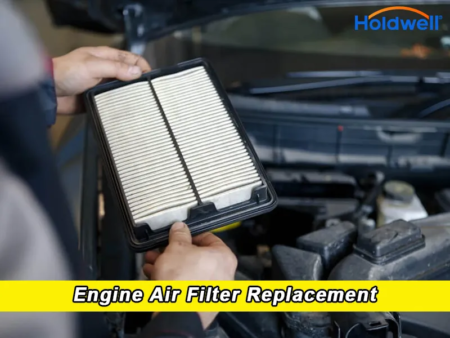
The engine air filter serves to shield precision moving engine hardware including pistons, cylinders and turbo impellers from abrasive grit wear.
What is a cabin air filter for?
In contrast, the cabin air filter focuses on protecting drivers and passengers’ respiratory health, while also maintaining the good condition of the HVAC evaporator coil.
2. Mount Location
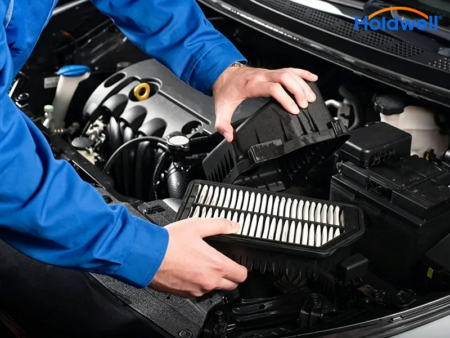
Engine air filters are installed under the hood inside a sealed rigid plastic and metal air intake housing. where is the cabin air filter
Where is the cabin air filter?
Cabin air filters sit inside the dashboard, usually behind the glove box or within compact HVAC duct housings.
3. Overall Structure
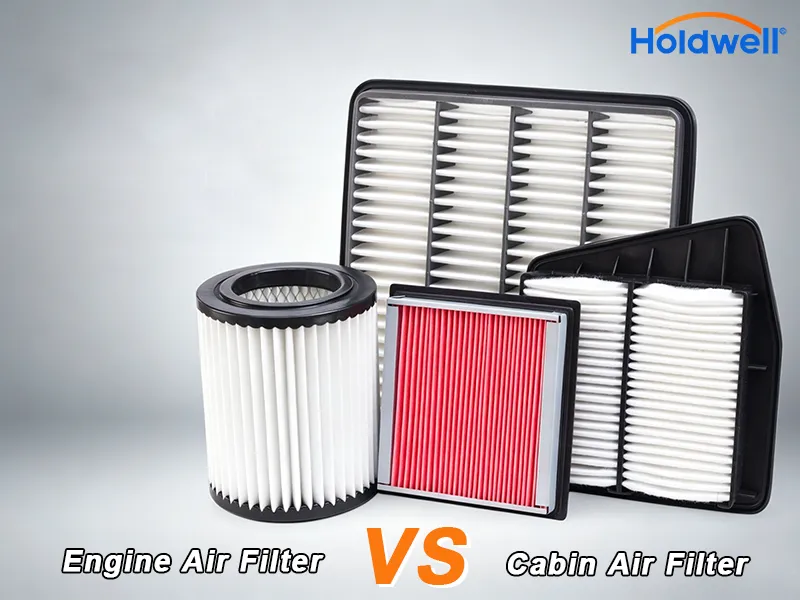
Engine air filters adopt a large-format design, either as rectangular panels or cylindrical canisters. Their filter media features deep, dense pleats strengthened by metal or rigid plastic inner support frames, which prevent deformation under powerful intake vacuum. Thick rigid PU or hard rubber sealing rims ensure an airtight fit against the filter housing.
Cabin air filters are exclusively thin, flat rectangular panels with shallow, fine pleats and no heavy load-bearing support skeleton. Lightweight soft foam rubber edge seals meet basic sealing needs for low-pressure air ducts.
4. Target Contaminants Filtered
Engine air filters block coarse, hard particles such as sand, road dirt, gravel dust, fallen leaves and large insect debris. They are specially engineered to stop abrasive solids that would scratch metal engine surfaces.
Cabin air filters trap fine micro pollutants: PM2.5, pollen, mold spores, exhaust particulates, fine road dust and smoke. They are capable of capturing soft irritants as well as absorbing gaseous odors.
5. Direct System Impact
The condition of the engine air filter directly affects engine horsepower output, throttle response, air-fuel combustion ratio, fuel economy, turbo service life and exhaust emission levels.
A clogged or worn cabin air filter weakens cabin vent airflow, reduces heating and cooling efficiency, triggers allergy symptoms, causes unpleasant interior odors, and accelerates mold growth on the evaporator.
6. Physical Size & Airflow Capacity
Engine air filters have a far larger footprint, engineered to deliver extremely high peak airflow volume to match combustion demands across idle, acceleration and high-RPM running states.
Cabin air filters are compact and slim, sized to fit low-volume, low-pressure air circulation powered by the HVAC blower motor.
7. Activated Carbon Layer
Activated carbon layers are never added to engine air filters, because carbon media would create excessive intake resistance and severely restrict engine airflow.
Mid-tier and premium OEM/aftermarket cabin air filters commonly integrate carbon composite layers, which adsorb toxic VOCs, exhaust fumes and chemical odors.
8. Working Pressure Condition
Engine air filters function under strong negative vacuum suction produced by piston movement, so they must endure high differential pressure without media collapse.
Cabin air filters work under low positive pressure supplied by the blower, meaning very little mechanical stress acts on the filter substrate.
9. Temperature Tolerance
Engine air filters are constructed to withstand extreme under-hood temperatures ranging from -40°C up to 120°C from engine radiant heat.
Cabin air filters can only operate under mild duct temperatures (maximum roughly 60°C). Their heat-sensitive foam seals and carbon media degrade rapidly when exposed to high heat.
10. Dust Holding Capacity
Thick filter media and deep pleats give engine air filters huge dust holding capacity; they can accumulate large amounts of grit before airflow becomes restricted.
Cabin air filters have limited dust storage due to their thin build, so they clog much faster in dusty cities or areas with heavy pollen counts.
11. Typical Service Interval
Standard passenger vehicle engine air filters last 20,000–40,000 km. For construction, agricultural and off-road vehicles operating in heavy dust, replacement is needed at 10,000 km or sooner.
Cabin air filters require replacement every 6–12 months or 10,000–15,000 km. Bi-annual changes are advised for allergy sufferers or drivers dealing with constant city stop-and-go traffic.
12. Reusability Option
Oil-impregnated cotton or foam engine filters for off-road use can be washed, re-oiled and reused repeatedly. Standard paper and synthetic dry engine filters are single-use disposable parts.
All cabin air filters are one-time replacement items. Washing ruins their electrostatic fine-particle trapping ability and deactivates activated carbon adsorption performance.
Simply put: The engine air filter safeguards your expensive engine assembly. The cabin air filter safeguards you and your passengers’ breathing environment.
Can engine air filters and cabin air filters be swapped or used interchangeably?
This misinformation circulates widely in DIY automotive forums, yet the two filtration parts are entirely non-interchangeable, for structural, pressure, material and functional reasons:
-
Installing a cabin filter into the engine intake: Thin, unsupported media collapses instantly under strong engine vacuum suction; shredded filter material and unfiltered massive volumes of abrasive sand blast cylinders and turbo impellers, causing catastrophic, costly engine damage within short driving distances. Cabin filter foam seals also melt rapidly in under-hood high heat.
-
Installing an engine air filter into the HVAC cabin system: Oversized rigid body will not fit compact HVAC housings; extremely dense thick media creates extreme airflow resistance, resulting in barely perceptible vent output from the heater and AC blower. Engine filter media contains no carbon or electrostatic layers, offering zero pollen, odor or VOC filtration for passengers.
Experienced service technicians universally confirm that swapping either filter is never a viable workaround. Fortunately, both filter replacements rank among the simplest, lowest-skill maintenance jobs vehicle owners can complete without specialized shop tools.
Conclusions
When comparing engine air filter vs cabin air filter, the foundational divide remains the vehicle system each component exists to protect—one safeguards high-value engine machinery, the other protects human occupants.
The heavy-duty engine air filter maintains peak horsepower, stable fuel efficiency and long engine service life by delivering clean combustion air under harsh under-hood temperature and vacuum conditions. The lightweight, often carbon-infused cabin air filter delivers purified, low-odor interior air and protects fragile HVAC cooling coils from mold and grime accumulation.
Though frequently overlooked during routine service checks, both filters deliver outsized value for vehicle reliability and driving comfort. Scheduled visual inspections and timely part replacement extend engine and HVAC component lifespans, cut long-term operating costs, and establish a healthier, smoother driving environment.
At Holdwell, we engineer precision-fit, high-durability filtration solutions for passenger autos, agricultural tractors, construction machinery, diesel generators and industrial equipment. Selecting OEM-equivalent premium replacement filters is a low-investment maintenance step that delivers multi-year reliable protection and steady, consistent operational performance across all working environments.