To solve this problem, piston cooling nozzles (also known as piston cooling jets) have become an indispensable key component in modern engine design. They provide targeted cooling and auxiliary lubrication for pistons, laying a solid foundation for efficient, stable, and durable engine operation.
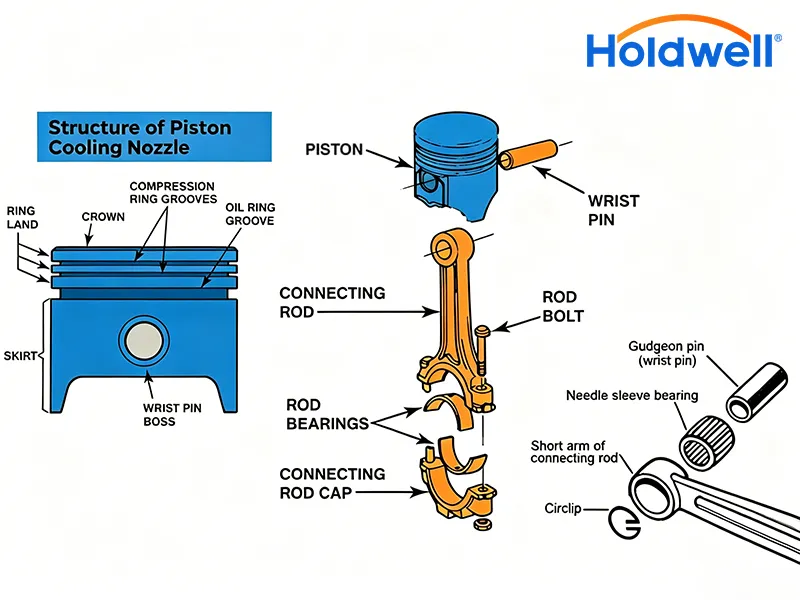
Structure of piston cooling nozzle
The piston cooling nozzle is a compact and precision-engineered component with a simple but scientific structural design, mainly consisting of three core parts: the nozzle body, the nozzle hole, and sealing accessories. In most heavy-duty and commercial engines, it is also equipped with a built-in check ball valve to realize pressure-controlled oil supply.
The nozzle body is the fixed mounting part of the entire component, which is stably installed on the engine cylinder block, directly below each piston cylinder bore. This fixed installation position ensures the accuracy of the oil spray angle and effectively avoids position deviation during long-term engine vibration.
The nozzle hole is the core functional passage, responsible for concentrating and ejecting engine oil at a stable flow rate and pressure. Matching with the built-in check valve structure, it can realize automatic switch of oil supply. The sealing parts mounted on the nozzle body ensure tight connection between the nozzle and the engine block, completely preventing oil leakage during oil transmission and pressure spraying, so as to guarantee stable oil pressure and continuous cooling effect.
How do piston cooling jets work?
The working process of the piston cooling nozzle follows fluid dynamics and thermodynamics principles, adopting targeted oil spray cooling rather than traditional water-based coolant cooling, which is the key to its efficient and reliable performance. Different from engine water cooling systems, piston cooling nozzles use engine lubricating oil as the cooling medium, which integrates cooling and lubrication functions.
The entire working process is automatically controlled by engine oil pressure. The system requires a stable oil pressure of approximately 1.7 Bar (25 Psi) to unseat the internal check ball of the nozzle. When the engine is idling, the oil pressure is insufficient to open the check valve, so the nozzle stops spraying oil, avoiding unnecessary energy consumption. When the engine runs at medium and high speeds or under heavy load, the oil pressure rises to the standard working value, pushing open the check ball and allowing lubricating oil to flow through the nozzle body and eject from the precision nozzle hole at a fixed pressure and angle.
The oil jet is accurately sprayed upward to the underside of the piston crown and evenly covers the back of the piston to form a continuous and stable oil film. This thin oil film fully contacts the high-temperature piston surface, quickly absorbing and taking away a large amount of combustion heat accumulated on the piston. After heat exchange, the high-temperature oil flows back to the engine oil pan, and the cooled new oil is circulated again, forming a continuous cooling cycle. For diesel engines with higher combustion temperature, this under-piston oil spray cooling method is the most mainstream and effective cooling technology, which can effectively avoid local overheating of the piston.
Roles and benefits of piston cooling nozzles
Piston cooling nozzles undertake multiple core tasks of thermal management and mechanical protection, playing an irreplaceable role in improving engine performance and reliability. Its functional value is mainly reflected in three key aspects.
First, it achieves efficient piston temperature control and prevents thermal damage. The continuous oil spray cooling significantly reduces the overall temperature of the piston and eliminates local high-temperature hot spots. It effectively avoids common engine faults such as piston thermal deformation, surface melting, crown cracking and cylinder scuffing caused by long-term high-temperature operation, greatly improving the piston’s high-temperature resistance and structural stability.
Second, it provides auxiliary lubrication to reduce mechanical friction loss. The sprayed lubricating oil not only cools the piston but also penetrates into the matching gap between the piston and cylinder liner, and lubricates the piston wrist pin and connecting rod small end. This reduces dry friction and mechanical wear between moving parts, lowers engine operation resistance, improves overall mechanical efficiency, and reduces fuel consumption to a certain extent.
Third, it maintains the overall thermal balance of the engine. The piston is the highest temperature component in the cylinder. Stable and uniform piston cooling balances the internal temperature difference of the engine cylinder group, avoids thermal stress concentration caused by uneven heating, ensures consistent piston-to-cylinder clearance, and maintains long-term stable operation of the engine under variable working conditions.
Conclusion
Piston cooling nozzle is a small but vital precision component that determines the reliability and service life of internal combustion engines. With a compact structure consisting of a nozzle body, precision nozzle hole and sealing structure, it relies on pressure-controlled oil spray circulation to achieve efficient cooling of the piston crown underside. By forming a uniform lubricating oil film, it solves the overheating problem of high-load engine pistons, while providing excellent lubrication protection for key moving parts.
For high-performance gasoline engines and heavy-duty diesel engines, reasonable piston cooling nozzle design and stable operation are crucial to suppress thermal faults, reduce friction loss, maintain engine thermal balance, and extend the overall service life of the engine. It is an essential core guarantee for modern engines to achieve high power, high efficiency and high durability.
FAQ About Piston Cooling Nozzles
1. What is a piston cooling nozzle?
A piston cooling nozzle, or piston cooling jet, is a precision component mounted on the engine cylinder block. Its core functions include piston thermal management and auxiliary lubrication for cylinder liners and piston wrist pins, effectively preventing piston overheating and reducing mechanical wear in modern internal combustion engines.
2. How is a piston cooled by cooling nozzles?
Pistons are cooled by pressurized engine oil sprayed from piston cooling nozzles. Each piston is built with internal cooling galleries. The nozzle injects oil to the piston’s underside, where the oil flows into the internal channels through bottom inlets, absorbs combustion heat, and drains out through reserved holes to complete a continuous cooling cycle.
3. Where does the piston cooling nozzle spray oil from?
Piston cooling nozzles are installed on the cylinder block, directly underneath each piston and cylinder bore. They spray a targeted upward oil jet onto the underside of the piston crown, covering high-temperature areas evenly for efficient, dead-zone-free piston cooling.
4. What is the standard working pressure for piston cooling nozzles?
Piston cooling nozzles operate based on specific oil pressure. They require approximately 1.7 Bar (25 Psi) of oil pressure to open the internal check ball and start continuous oil spraying. The nozzle remains closed during engine idling with low pressure and activates only at medium to high engine loads for energy-saving and stable cooling performance.
5. How does coolant and cooling oil enter and circulate around pistons?
Cooling oil enters the lower engine block around the crankshaft and cylinder liners, the hottest areas during engine operation. Driven by the oil pump, pressurized oil flows upward to cool pistons and lubricate cylinder walls in real time. This steady circulation stabilizes piston clearance and reduces internal heat buildup.
6. How are diesel pistons cooled with nozzles?
Diesel engines run at higher temperatures and heavier loads, placing higher demands on piston cooling. Most diesel pistons adopt under-head oil cooling, mainly via two oil supply methods: lubrication from the connecting rod small end and fixed piston cooling nozzles at the cylinder bore bottom. Nozzle-based cooling delivers more uniform, stable cooling effect, ideal for long-term heavy-duty diesel engine operation.