Most roadside breakdowns and unexplained engine performance drops trace back to a faulty crankshaft position sensor (CKP sensor). The most searched question can not bypass:
“How do I tell if the crankshaft position sensor is bad?”
As a professional engine parts supplier, Holdwell consolidates practical, field-tested knowledge in this guide, helping you quickly diagnose, repair and resolve CKP sensor issues without redundant maintenance or part replacement.
Signs of a bad crankshaft position sensor
Crankshaft position sensor problems rarely appear all at once. In most cases, symptoms develop gradually as the sensor weakens due to heat, vibration, contamination, or internal electrical failure.
One of the earliest and most common symptoms is difficult starting. The engine may crank longer than normal before starting, especially when hot.
As the sensor deteriorates further, the ECU may stop receiving crankshaft signals entirely, causing a complete no-start condition.
2. Intermittent engine stalling
A failing CKP sensor can lose signal intermittently during operation. This often causes sudden engine stalling while idling, accelerating, or driving at low speeds.
In many cases, the engine restarts after cooling down because heat temporarily affects the sensor’s internal circuitry.
3. Rough idle and misfires
Because the ECU relies on crankshaft timing signals for combustion control, inaccurate data can lead to:
-
Rough idling
-
Engine vibration
-
Cylinder misfires
-
Hesitation
-
Uneven engine operation
Drivers may notice unstable RPM fluctuations or shaking during idle.
Incorrect ignition timing and delayed fuel injection reduce combustion efficiency. This can result in poor throttle response, weak acceleration, and noticeable power loss under load.
5. Check engine light
Most CKP sensor failures trigger the check engine light. Common OBD-II trouble codes include:
-
P0335
-
P0336
-
P0337
-
P0338
-
P0339
These codes indicate crankshaft position sensor circuit or signal problems.
Some failing sensors work normally when cold but fail once engine temperatures rise. This creates unpredictable shutdowns that are difficult to diagnose without proper testing equipment.
What causes a crankshaft position sensor to fail?
Crankshaft position sensors rarely fail due to poor part quality. Most premature or repeated failures result from harsh engine conditions, contamination, faulty installation, wiring damage, and mechanical wear. Below are the most common causes compiled by Holdwell for quick troubleshooting.
1. Excessive heat & thermal fatigue
Oil sludge, carbon buildup, metal shavings and grime accumulate on the sensor tip and mounting surface. These contaminants disrupt the precise gap between the sensor and reluctor wheel, distorting timing signals, activating fault codes, and causing sensor failure. Many post-replacement issues stem from uncleaned mounting points, not defective sensors.
Sensor wiring endures constant heat, vibration and friction from nearby moving and hot components, leading to worn insulation, cracked wires and short circuits. Corroded or loose connectors also cause unstable signal transmission. These wiring issues are frequently misdiagnosed as sensor failure, causing unnecessary replacements.
Over-torqued mounting bolts crack the sensor housing and internal components. An incorrect air gap (too wide or too narrow) weakens signals or causes physical friction. Reused worn O-rings, misalignment and incomplete installation also lead to premature failure and intermittent engine performance issues.
Heavy vibration from industrial equipment and heavy-duty vehicles loosens sensor fasteners, damages internal structures and destabilizes signal output. Long-term vibration fatigue impairs the sensor’s timing synchronization function, causing persistent operational faults.
Crankshaft position sensors wear naturally over time. Aging internal magnetic components and circuit boards weaken signal accuracy, leading to intermittent rough idle, acceleration hesitation and occasional no-start problems before complete failure.
Unstable voltage, faulty batteries and ECU abnormalities generate irregular current surges that burn the sensor’s internal circuits. Though less common, this issue often causes sudden sensor failure after part replacement or battery service.
Most premature sensor failures are avoidable. Clean mounting surfaces thoroughly, inspect wiring condition, maintain standard air gaps, and avoid over-torquing bolts during installation. These simple steps extend sensor lifespan and prevent recurring timing faults.
How to test a crankshaft position sensor?
Replacing a CKP sensor without testing can waste time and money. Proper diagnosis helps confirm whether the sensor itself is faulty or if the issue comes from damaged wiring, connectors, or related components.
Start with a basic visual inspection.
Check for:
-
Damaged sensor housing
-
Loose connectors
-
Corroded terminals
-
Oil contamination
-
Frayed or broken wires
-
Metal debris on the sensor tip
Many CKP sensor issues are actually caused by wiring harness damage rather than sensor failure.
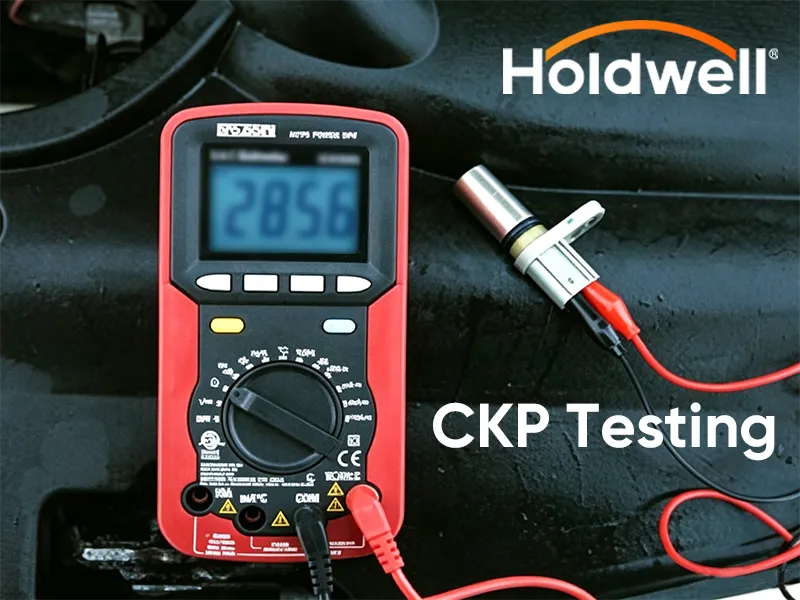
For magnetic inductive sensors, measure internal resistance using a multimeter.
Typical readings usually range between 200 and 1000 ohms, depending on manufacturer specifications.
Results interpretation:
-
Normal resistance = sensor likely functional
-
Infinite resistance = open circuit
-
Zero resistance = internal short circuit
Always compare readings with the vehicle’s service manual.
While cranking the engine, measure sensor output voltage.
A functioning sensor should generate fluctuating voltage pulses. If voltage remains flat or unstable, the sensor may be defective.
Hall-effect sensors require checking:
-
Reference voltage
-
Ground circuit
-
Digital signal switching
Professional scan tools allow technicians to monitor live engine RPM data during cranking.
If RPM readings remain at zero while the engine cranks, the CKP sensor or its circuit may have failed.
Advanced scanners can also display crankshaft synchronization status and signal interruptions.
For precise diagnosis, oscilloscopes provide the most accurate evaluation.
Oscilloscope testing can identify:
-
Weak waveforms
-
Missing pulses
-
Signal distortion
-
Reluctor ring damage
This method is especially useful for intermittent failures.
How to check crankshaft position sensor wiring?
A malfunction related to crankshaft position detection does not always stem from a defective sensor. Please carry out the below checks prior to replacement:
-
Continuity of the wiring harness
-
Connection condition of connector pins
-
Communication status with ECU
-
Reliability of ground connections
-
Normal operating voltage supply
Excessive heat around the engine block ages wiring insulation over time, making it brittle and prone to internal wire damage. Loose terminals or corrosion on connectors will interfere with signal transmission, resulting in false sensor fault indications.
Temporary fix for crankshaft position sensor
There is no true long-term temporary fix for a failing CKP sensor. However, if the sensor becomes heat-sensitive, allowing the engine to cool may temporarily restore operation.
In some cases, cleaning contaminated connectors or repairing loose wiring may briefly improve signal stability.
Still, once the sensor begins failing internally, replacement is the only reliable solution. Continuing to drive with an unstable CKP sensor can lead to unexpected stalling and unsafe driving conditions.
Conclusion
The crankshaft position sensor is a small component with enormous influence over engine performance. When it begins to fail, symptoms such as hard starting, stalling, rough idle, misfires, and power loss can quickly disrupt vehicle operation.
Accurate testing and diagnosis are essential before replacement. By inspecting wiring, verifying signal output, and using proper diagnostic tools, technicians can identify CKP sensor failures more efficiently and avoid unnecessary repairs.