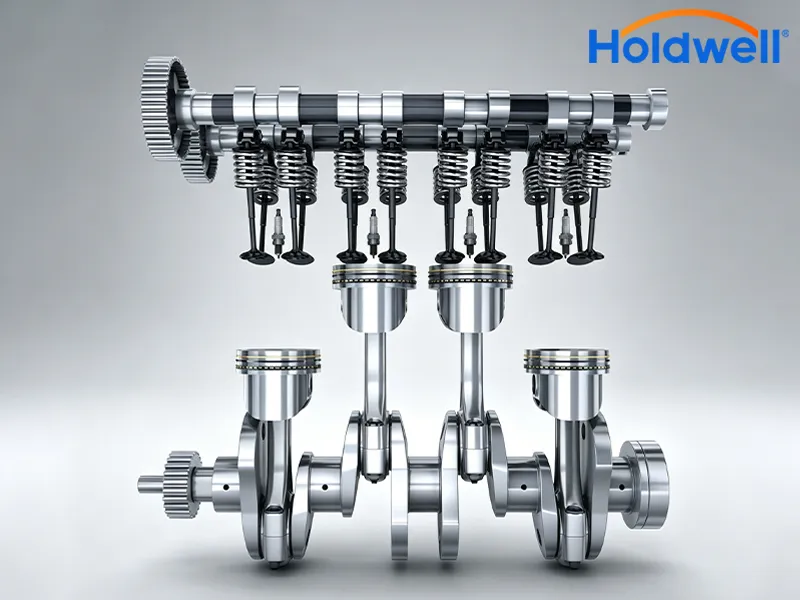
Inside every internal combustion engine, thousands of controlled explosions happen every minute. But explosions alone do not move a machine forward. The work begins when the crankshaft converts that combustion force into usable rotary power.
So, what is a crankshaft in an engine?
A crankshaft is the core rotating component that transforms the pistons’ up-and-down motion into rotational movement. That rotary motion is then transferred through the drivetrain to power the wheels, hydraulic systems, ptos, generators, or heavy equipment attachments.
Without a crankshaft, the engine simply cannot operate.
At Holdwell, we work with replacement engine parts for agricultural, construction, industrial, and power generation equipment every day. We know that a crankshaft is not just another metal component — it is one of the most critical parts determining engine durability, balance, and long-term performance.
What does a crankshaft do in an engine?
The crankshaft performs several essential functions simultaneously inside the engine.
Its primary role is motion conversion. As fuel ignites inside the cylinder, the piston moves downward with tremendous force. The connecting rod transfers this linear motion to the crankshaft, which converts it into continuous rotational motion.
But the crankshaft does far more than simply rotate.
A properly engineered crankshaft also:
● Transfers engine power to the transmission or drivetrain
● Maintains engine balance and reduces vibration
● Supports smooth engine operation between combustion cycles
● Drives timing components such as gears or chains
● Powers auxiliary systems like oil pumps and camshafts
● Absorbs and distributes massive combustion forces
In heavy-duty diesel engines and industrial machinery, these functions become even more critical because the loads are significantly higher than in passenger vehicles.
That is why crankshaft quality directly affects:
● Engine efficiency
● Fuel consumption
● Reliability
● Vibration control
● Bearing life
● Overall engine lifespan
How does a crankshaft work?
To understand how a crankshaft works, it helps to look at the four-stroke combustion process.
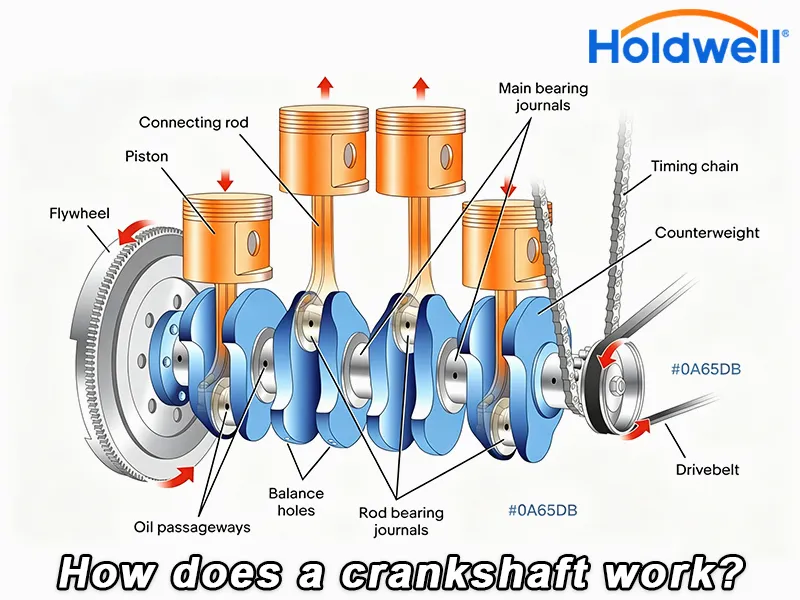
During combustion, fuel ignites and forces the piston downward inside the cylinder. The connecting rod links the piston to the crankshaft journal. Because the crank pin is offset from the crankshaft centerline, the downward piston movement creates rotational force.
This continuous sequence of combustion events produces steady engine rotation.
The process looks simple externally, but internally it involves extreme forces, temperatures, and precision timing.
Even slight crankshaft imbalance can lead to:
● Excessive vibration
● Premature bearing wear
● Oil seal failure
● Reduced engine efficiency
● Catastrophic engine damage
That is why modern crankshafts are manufactured with extremely tight tolerances and carefully balanced counterweights.
Main parts of a crankshaft
A crankshaft contains multiple precision-machined sections working together as a single rotating assembly.
Main journals
These are the primary bearing surfaces supporting the crankshaft inside the engine block. They allow smooth rotation under heavy load.
Crank pins (rod journals)
The connecting rods attach to these offset journals. Their position creates the rotational movement needed for torque generation.
Crank webs
Crank webs connect the main journals and crank pins together. Their geometry determines crankshaft strength and engine firing characteristics.
Counterweights
Counterweights help balance rotating forces and minimize vibration. Proper balancing improves engine smoothness and reduces stress on bearings.
Oil passages
Internal oil channels lubricate the bearings and journals during operation. Proper lubrication is essential for crankshaft survival under high rpm and heavy loads.
What materials are crankshafts made from?
Crankshafts operate under enormous stress. Every combustion cycle produces torsional force, bending force, heat, and vibration.
Because of these extreme conditions, material selection is critical.
Forged steel crankshafts
Forged steel crankshafts are commonly used in heavy-duty diesel engines, industrial equipment, and performance applications.
Advantages include:
● Exceptional strength
● High fatigue resistance
● Longer service life
● Better resistance to shock loads
Forged crankshafts are ideal for high-torque environments such as construction equipment, tractors, generators, and commercial machinery.
Cast iron crankshafts
Cast crankshafts are more economical and widely used in lower-load engines.
They provide:
● Lower manufacturing cost
● Good wear resistance
● Suitable durability for standard applications
However, they are generally less resistant to extreme stress compared to forged steel designs.
Surface hardening treatments
Modern crankshafts often receive additional treatments such as:
● Induction hardening
● Nitriding
● Precision polishing
These processes improve wear resistance at bearing surfaces while maintaining core toughness.
Why is crankshaft balance so important?
Engine balance directly affects performance and component longevity.
As the crankshaft rotates, uneven forces naturally develop from piston movement and combustion timing. If those forces are not controlled, vibration increases dramatically.
A balanced crankshaft delivers multiple advantages for engine performance and daily operation. It effectively cuts down engine noise, lessens vibration and offers reliable protection to bearings. Meanwhile, it helps boost fuel economy and prolong the overall service life of the engine. With smoother running conditions, it also reduces operator fatigue during long working hours.
In heavy equipment and diesel engines, imbalance can quickly damage:
-
Main bearings
-
Connecting rod bearings
-
Flywheels
-
Seals
-
Timing components
That is why precision balancing is essential during both manufacturing and engine rebuilding.
Crankshaft vs camshaft: What’s the difference?
The crankshaft and camshaft work together, but they perform completely different tasks.
The crankshaft converts piston motion into rotary power.
The camshaft controls valve timing by opening and closing intake and exhaust valves at precise intervals.
These two components stay synchronized through timing gears, chains, or belts. If synchronization fails, serious engine damage can occur.
Why crankshaft quality matters?
In modern engines, efficiency and durability depend heavily on crankshaft precision.
Poor-quality crankshafts can lead to:
-
Premature wear
-
Excessive vibration
-
Bearing failure
-
Reduced engine efficiency
-
Shorter service life
At Holdwell, we understand how critical engine reliability is for agriculture, construction, industrial power, and heavy-duty applications. High-quality replacement engine components help reduce downtime, improve performance, and protect long-term equipment investment.
Conclusion
The crankshaft is one of the most important components inside any engine. It transforms combustion energy into usable rotational power while maintaining balance, stability, and synchronization throughout the engine system.
From material strength to precision balancing, every detail of crankshaft manufacturing directly impacts engine performance and durability.
Whether in tractors, generators, excavators, forklifts, or industrial diesel engines, a properly engineered crankshaft is essential for dependable operation under demanding conditions.
Understanding how a crankshaft works not only helps diagnose engine problems earlier — it also highlights why investing in high-quality engine components matters for long-term reliability.