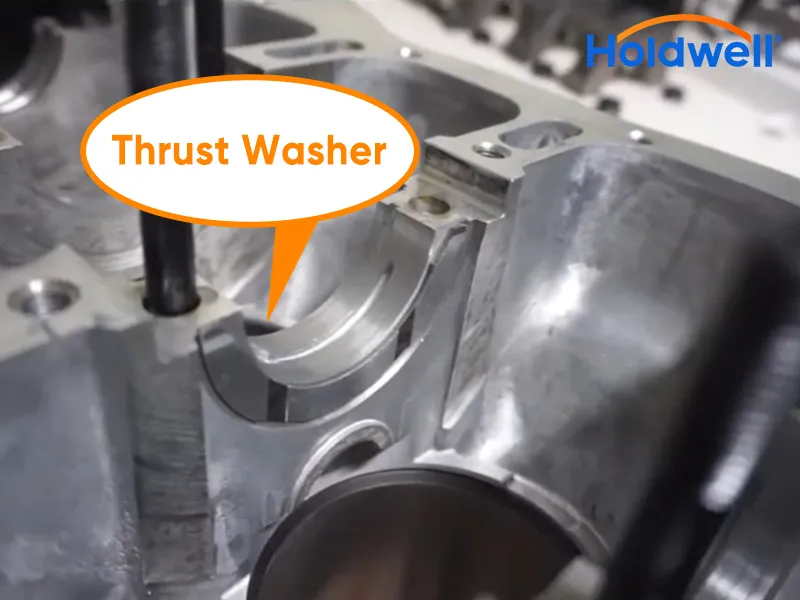
So, what is a thrust washer?
A crankshaft thrust washer is a flat bearing surface designed to control axial movement—the forward and backward motion—of rotating components such as a crankshaft. It acts as a wear-resistant barrier between moving parts, preventing excessive end-to-end movement while reducing friction.
What does a thrust washer do?
Its primary job is to absorb axial loads and maintain proper component alignment. In an engine, crankshaft thrust washers prevent the crankshaft from moving excessively forward or backward during operation, protecting bearings, pistons, transmission components, and other critical parts from premature wear.
Although thrust washers are relatively inexpensive compared to major engine components, their importance should never be underestimated.
Why axial movement matters?
Most people think engine components only rotate.
In reality, rotating components often experience forces in multiple directions.
A crankshaft, for example, doesn’t simply spin. Every time the clutch is engaged, transmission loads change, or engine torque fluctuates, the crankshaft experiences axial force that tries to push it forward or pull it backward.
Without a properly functioning thrust washer, this movement can become excessive.
The result may include:
-
Increased crankshaft end play
-
Accelerated bearing wear
-
Clutch engagement issues
-
Transmission alignment problems
-
Damage to crankshaft thrust surfaces
-
Reduced engine life
This is why controlling axial movement is just as important as supporting rotational loads.
How a crankshaft thrust washer works?
In most internal combustion engines, thrust washers are installed at one of the main bearing locations on the crankshaft.
Their position allows them to contact specially machined thrust faces on the crankshaft.
When axial force is generated, the crankshaft attempts to move along its axis.
Instead of allowing metal-to-metal contact between the crankshaft and engine block, the thrust washer absorbs the load.
A thin film of engine oil forms between the mating surfaces, minimizing friction and wear.
This creates a controlled clearance known as crankshaft end float.
The goal is not to eliminate movement entirely.
Rather, the objective is to allow a small amount of controlled movement while preventing excessive travel that could damage surrounding components.
Where are thrust washers used?
Although commonly associated with engines, thrust washers are used throughout many types of machinery.
You can find them in:
Automotive engines
Crankshaft thrust control is the most common application.
Agricultural equipment
Tractors and harvesting equipment rely on thrust washers to manage axial loads in engines, transmissions, and PTO systems.
Construction machinery
Heavy-duty equipment often uses thrust washers in driveline and gearbox assemblies.
Industrial engines
Generators, pumps, compressors, and stationary power systems utilize thrust washers to maintain alignment under continuous operating loads.
Gearboxes and transmissions
Rotating shafts frequently require thrust washers to prevent axial movement that could affect gear engagement.
Wherever rotating components encounter side loads, thrust washers are likely involved.
What are thrust washers made of?
The material depends on operating conditions and load requirements.
Common materials include:
Bronze
Bronze thrust washers offer excellent wear resistance and are widely used in industrial applications.
Steel-backed bearing materials
Many modern engine thrust washers use steel backing combined with specialized bearing overlays.
Aluminum-based alloys
Lightweight and suitable for many engine applications.
Copper-lead materials
Designed to handle higher loads while maintaining durability.
Material selection is critical because thrust washers must withstand constant friction, temperature fluctuations, and repeated loading cycles.
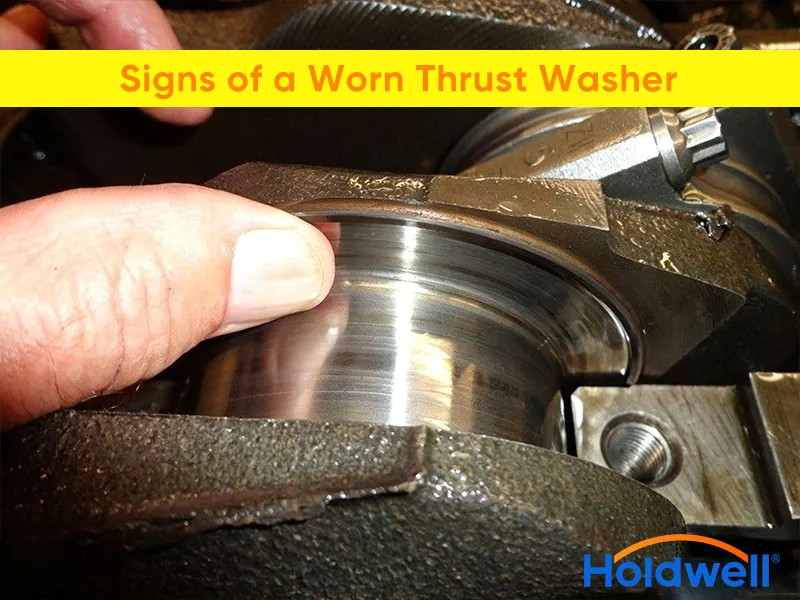
Signs of a worn thrust washer
Like any wear component, thrust washers eventually reach the end of their service life.
Common symptoms include:
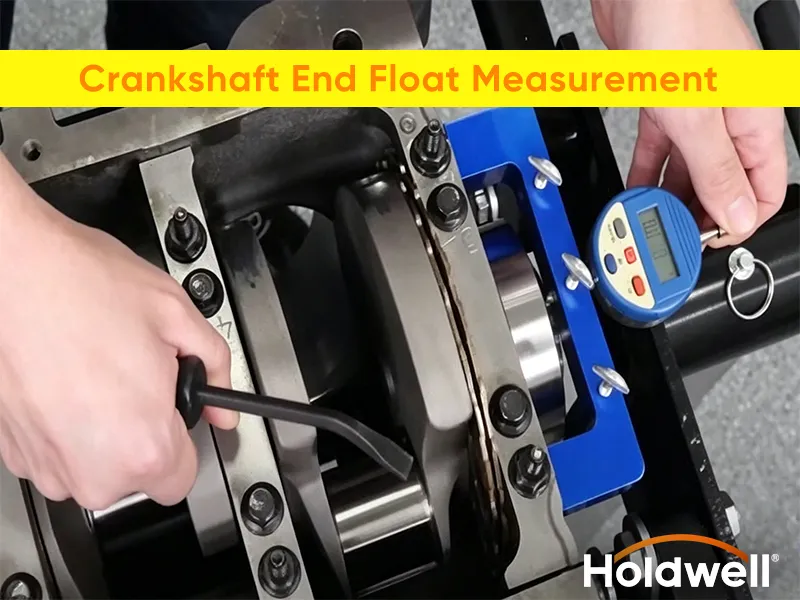
Excessive crankshaft end play
This is often the first measurable indication of wear.
A dial indicator can confirm whether crankshaft movement exceeds manufacturer specifications.
Clutch-related problems
When crankshaft movement becomes excessive, clutch operation may feel inconsistent.
Unusual engine noises
Knocking or clicking sounds during clutch engagement can indicate excessive axial movement.
Accelerated bearing wear
Misalignment caused by excessive end float can place additional stress on main bearings.
Transmission concerns
In severe cases, excessive crankshaft movement may affect transmission alignment and operation.
Ignoring these symptoms can allow minor wear to develop into major engine damage.
What causes thrust washer failure?
Several factors contribute to premature thrust washer wear.
Excessive clutch loading
Frequent clutch use generates continuous axial force on the crankshaft.
Poor lubrication
Insufficient oil supply increases friction and accelerates wear.
Contaminated engine oil
Metal particles and debris can damage bearing surfaces over time.
Improper installation
Incorrect clearances or misaligned components can shorten service life significantly.
High engine mileage
Even under ideal operating conditions, wear accumulates gradually over thousands of operating hours.
Understanding the root cause is essential before simply replacing a worn washer.
Why measuring crankshaft end float is important?
Many technicians focus immediately on replacing thrust washers once wear is suspected.
However, measurement should always come first.
Crankshaft end float provides valuable information about the condition of both the thrust washers and the crankshaft thrust surfaces.
In some high-mileage engines, original thrust washers may still remain within specification.
Conversely, installing new thrust washers without checking crankshaft condition may fail to solve the underlying problem.
Accurate measurement allows technicians to determine whether replacement is necessary and whether additional repairs may be required.
Can a bad thrust washer damage an engine?
Absolutely.
A severely worn thrust washer can allow excessive crankshaft movement, leading to:
-
Main bearing damage
-
Crankshaft thrust surface wear
-
Clutch system problems
-
Transmission misalignment
-
Reduced oil film stability
-
Catastrophic engine failure in extreme cases
Because the thrust washer controls crankshaft positioning, its condition directly affects multiple engine systems.
A relatively inexpensive component can therefore have a significant impact on overall engine reliability.
Conclusion
The thrust washer may be one of the smallest components inside an engine, but it performs one of the most important jobs. By controlling axial movement, maintaining crankshaft alignment, and absorbing thrust loads, it protects critical engine and drivetrain components from excessive wear.
Understanding what a thrust washer is and what it does helps operators recognize potential issues before they become costly repairs. Whether you’re maintaining agricultural equipment, construction machinery, industrial engines, or automotive applications, regular inspection of crankshaft end float and proper lubrication can significantly extend thrust washer life.
At Holdwell, we believe that reliable equipment starts with understanding the components that keep everything running smoothly—even the small ones that are often overlooked.